




Best Light Spectrum to Grow Autoflowers

- 1. What is light spectrum?
- 2. Light spectrums in each stage
- 3. Types of light
- 3. a. Light bulbs: hps, mh, cfl, and hid
- 3. b. Full spectrum leds, and infrared and uv lights
- 3. c. Can light spectrum improve trichome production?
- 3. d. Can light spectrum improve yields?
- 4. The best autoflower light spectrum
- 5. In conclusion
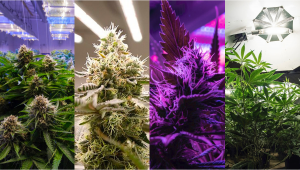
When growing autoflowering plants indoors, we need to simulate the environment they naturally grow in. The environment includes humidity, temperature, and the most essential of them all: light. When growing indoors, the best light spectrum is one that comes as close as possible to the sun's spectrum. In 2026, this is referred to as a full spectrum. Whether you prefer light bulbs or LEDs, you need the right light spectrum in each stage for optimal plant growth.
1. What is Light Spectrum?
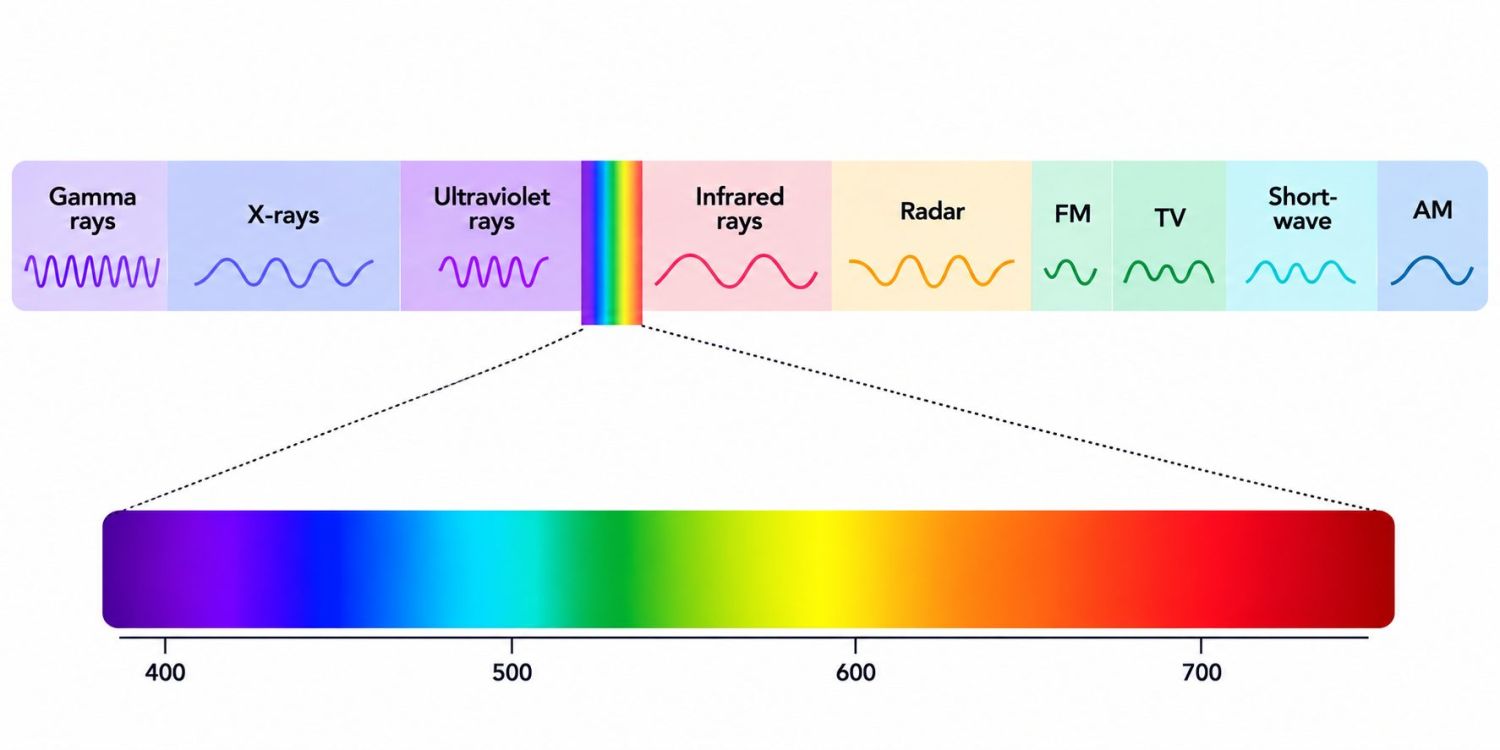
The light spectrum is the different colors (aka wavelengths) a source of light can emit. Light is measured in nanometers (nm), and each nanometer represents a band of light (a band of light is a section in the color spectrum). Humans can see a small part of the spectrum, between 380 and 780 nanometers, which means we can only see the colors ranging from violet to red. Even though it appears white, the sun is a full-spectrum light source and contains the whole spectral wavelength. That’s why rainbows happen. When raindrops refract light into individual wavelengths, you can see all the colors (visible to humans) that make up sunlight.
In nature, cannabis plants grow under the sun, receiving the whole spectrum of wavelengths. This means we have to provide the maximum amount of wavelengths possible for the best development of our cannabis plant. Although it’s not essential, it is considered good to provide the best light spectrum to encourage plant growth. Remember, this is not a rule; you can grow your cannabis plant from seed to harvest with any light spectrum or amount of light, but this can seriously affect your harvest.
2. Light Spectrums in Each Stage
Best light spectrum for growing plants
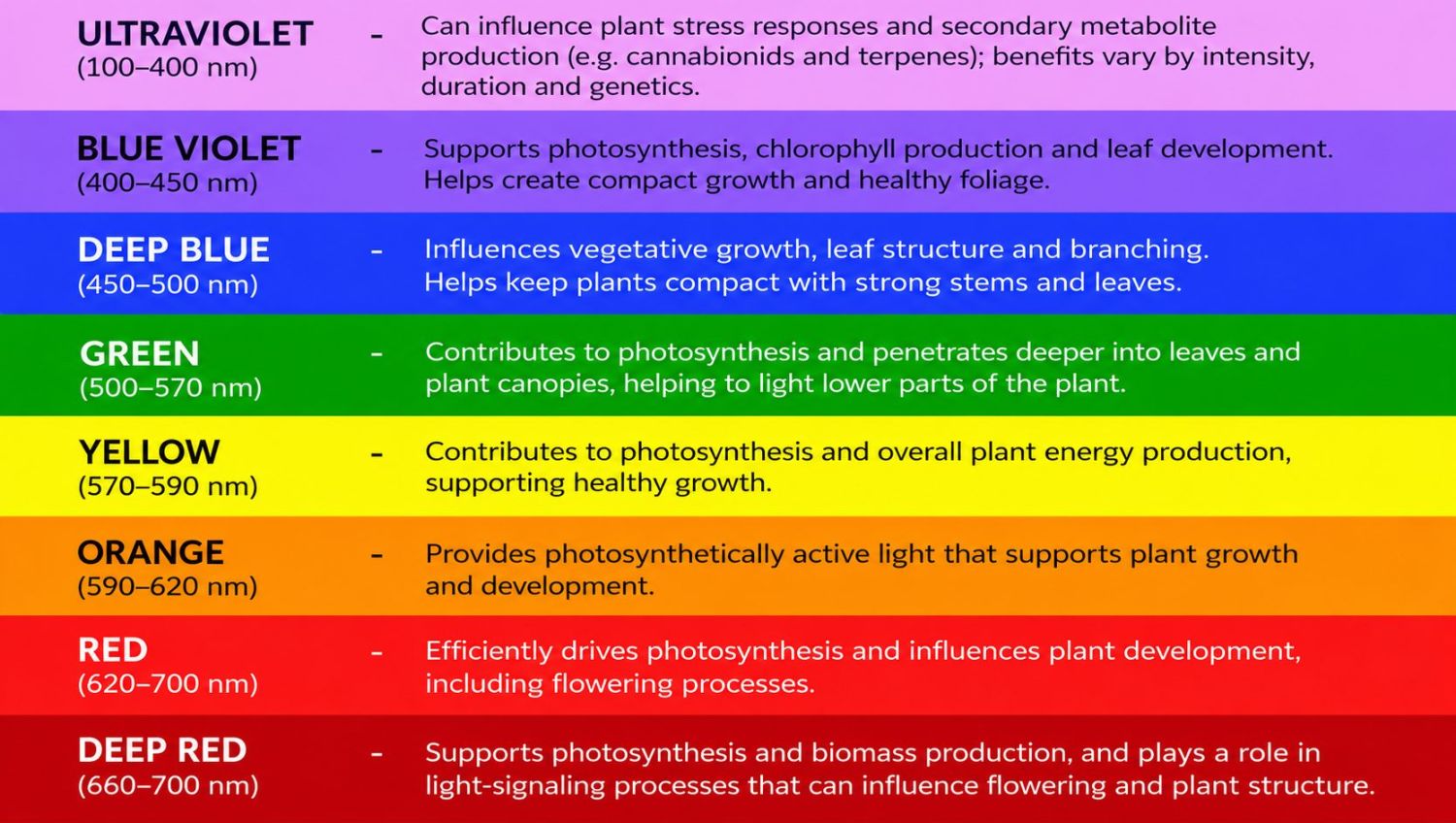
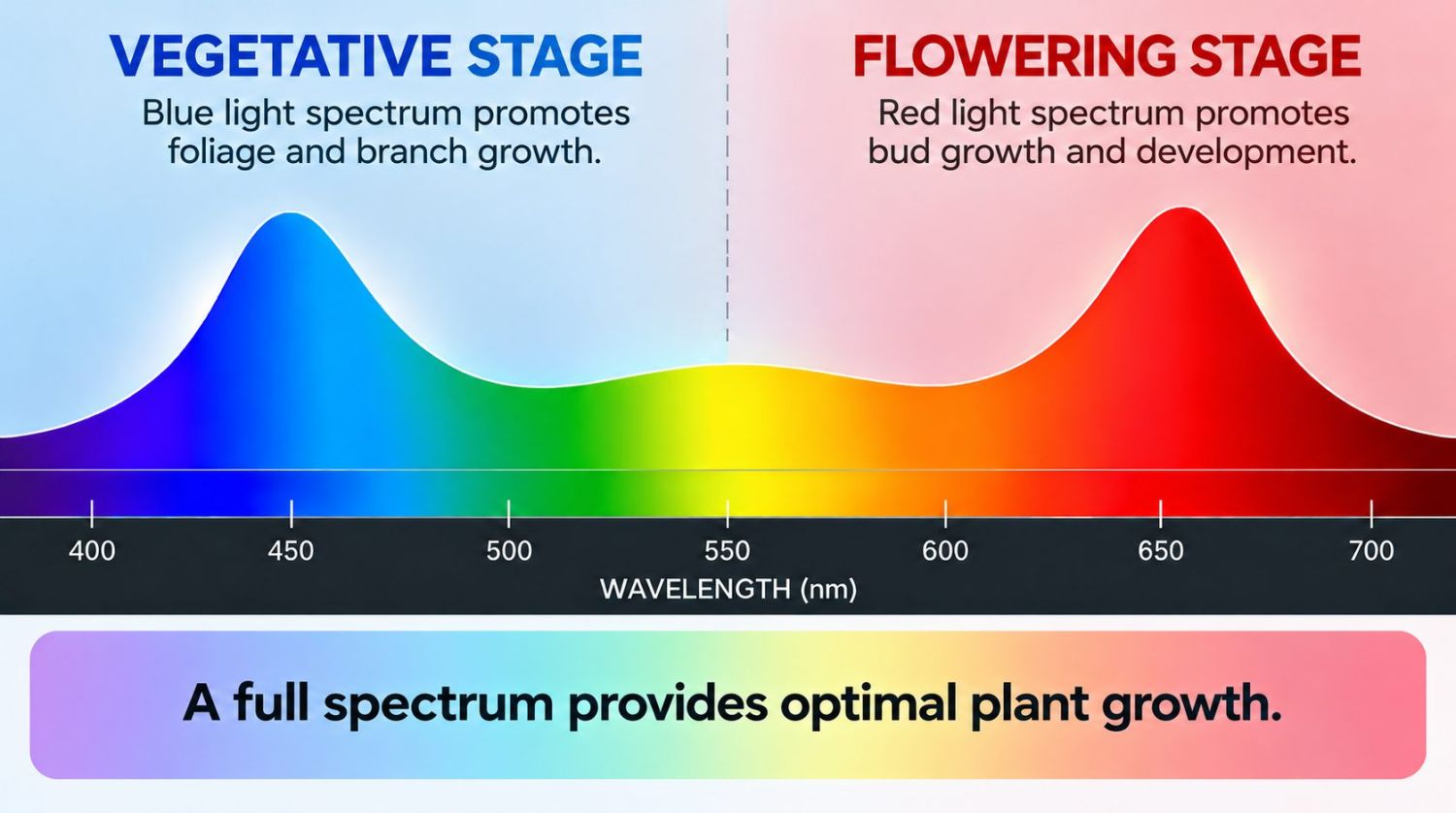
During the vegetative stage, cannabis needs blue wavelengths to grow strong, big, and promote leaf growth. When growing indoors, we aim to grow as many leaves as possible. With more leaves, there is more surface to absorb light. This way, we ensure our plant develops a strong stem and branches, preparing it for the flowering stage.
Best light spectrum for blooming plants
When entering the flowering stage, cannabis in the wild uses red wavelengths to promote bud formation. If we want to produce dense buds and increase yields, we need to provide the plant with red wavelengths; this will increase the rate of photosynthesis, thus increasing bud formation.
Generally speaking, “blue” light results in more vertical growth, whereas “red” light results in more horizontal growth.
3. Types of Light
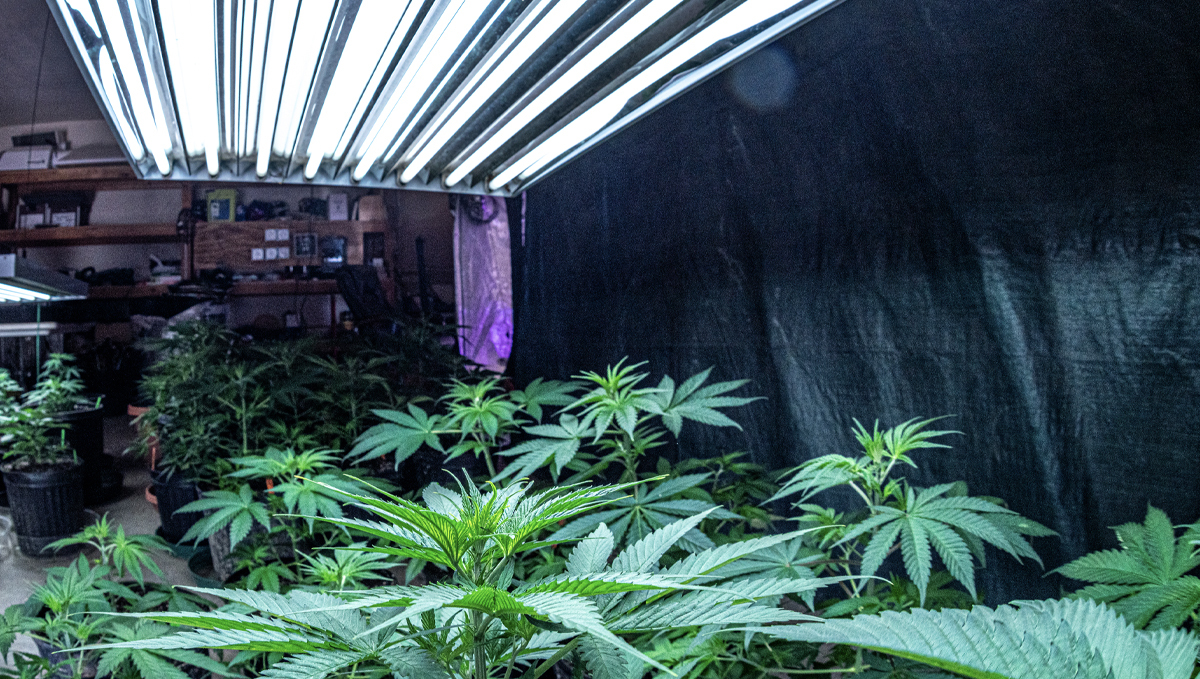
Cannabis grow lights are usually divided into two kinds: light bulbs and LEDs. Light bulbs emit a limited scope of wavelengths, meaning there are colors of the light spectrum they don’t emit. Therefore, they are narrow-spectrum lights. LEDs emit almost all the colors in the spectrum. They are composed of blue, red, and white diodes, allowing them to emit all or almost all the wavelengths of the spectrum, therefore making them full- or wide-spectrum lights.
LEDs vs Light Bulbs
| LEDs | Bulbs |
|---|---|
| Expensive | Cheap |
| More efficient | Consume more electricity |
| Take less space | Need more space |
| Runs cooler | Emit a lot of heat |
Light Bulbs: HPS, MH, CFL, and HID
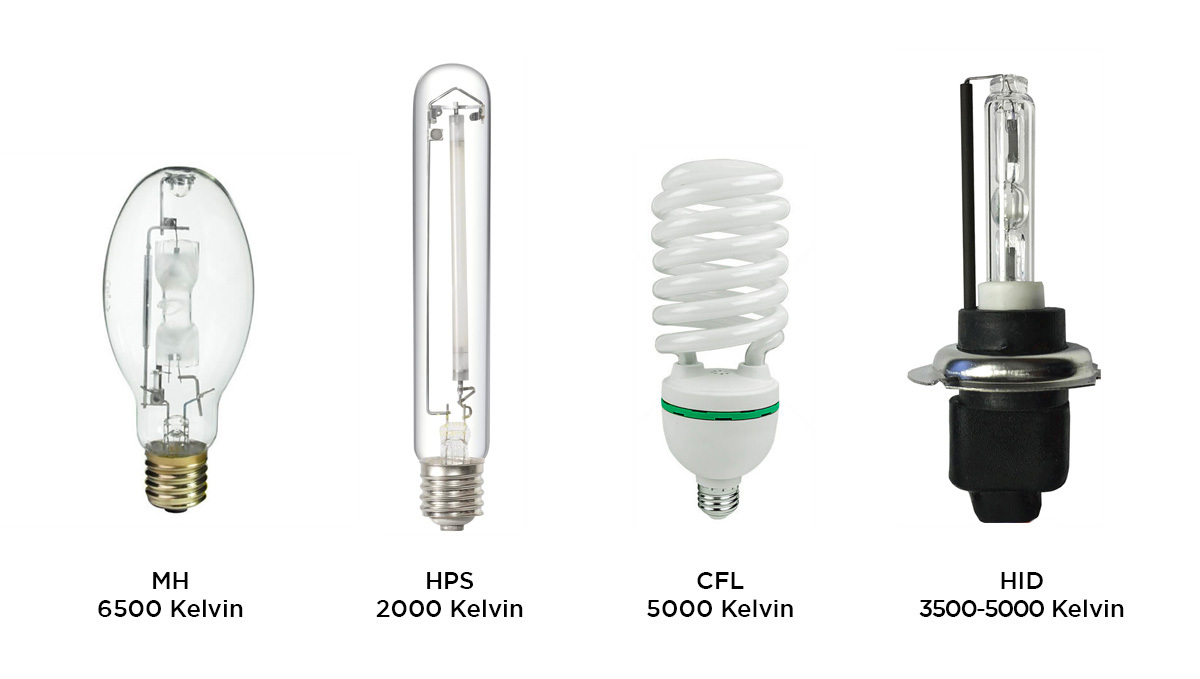
Light bulbs come in four types: Metal Halide (CMH), High Pressure Sodium (HPS), Compact Fluorescent Lights (CFL), and High Intensity Discharge (HID). MH bulbs are rated around 6500 Kelvin and are usually used for cannabis in the vegetative stage because they emit “blue” light (aka colder light). HPS bulbs are rated at 2000 Kelvin and are usually used for cannabis in the flowering stage for their “red” light (aka warmer light).
CFLs are rated at around 5000 Kelvin. They emit a very weak “blue” light and are only used with cannabis seedlings and clones, as they just need to develop roots for the first couple of days. When the vegetative stage begins, they should be transferred to a growing space with stronger lighting. HID can cover from 3500 to 5000 Kelvin. They are similar to HPS but contain xenon inside, thus emitting a different light spectrum and are more efficient while being more compact.
You can also grow your plants under both CMH and HPS bulbs. This is called a mixed light spectrum and will ultimately result in a better harvest.
Pros:
- Cheaper than average LED lights
- You don’t need to change the whole fixture, just replace the bulb
Cons:
- Electricity cost is higher if compared to LEDs.
- Need extra equipment for cooling.
- Requires changing bulbs (CMH to HPS) when entering the flowering stage.

Full Spectrum LEDs, and Infrared and UV Lights
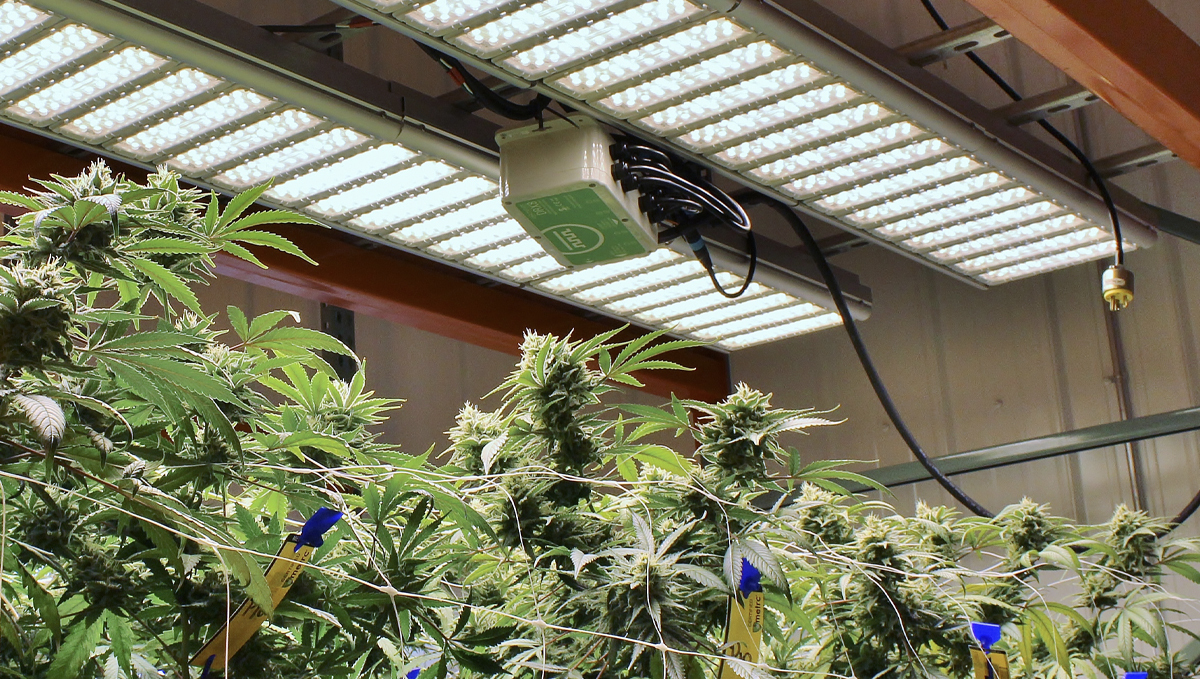
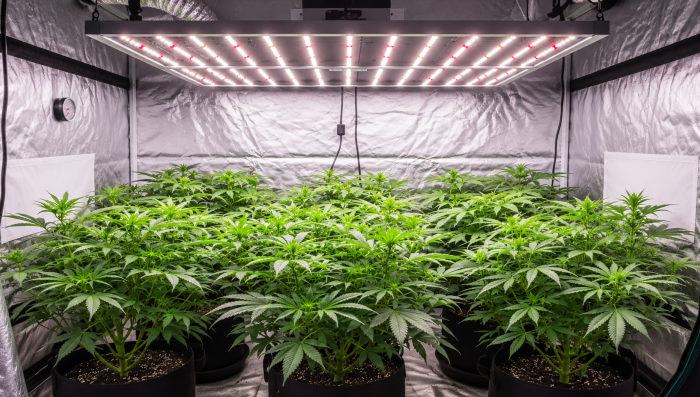
All LEDs are full-spectrum lights unless advised. They may not contain all wavelengths but will emit the needed amount for each stage of cannabis plant growth. Unlike light bulbs, you won’t have to change anything other than your timer when you’re about to enter the flowering stage. You can find full-spectrum LEDs that have UV and infrared diodes. If not, there are LEDs designed to emit those spectrums. They’re not that common in cannabis indoor growing but are said to benefit growers.
Just like everything else on the planet, cannabis plants are damaged by too much UV light, but at the right amount. It can promote trichome production, as cannabis plants produce trichomes to protect themselves from too much light. Like UV lights, infrared lights can harm your plants in excess, but at the right amount, they can boost photosynthesis and affect yields, plant growth, and plant health in a positive way.
Pros:
- Used on the entire life cycle.
- Energy-saving.
- Longer lifetime than bulbs.
Cons:
- Higher cost.
It’s unusual to have UV and Infrared lights. They’re expensive and are NOT essential for growing good flowers. They’re recommended for more experienced growers who want to experiment with different spectrums. If you want to learn a bit more about UV lights, here’s some information that might help you make the right decision when shopping for these types of lights:
UVA Lights
UVA is part of a cannabis plant’s natural environment, so it can enhance cannabinoid and terpene production when introduced at the right time.
UVB Lights
UVB can enhance plant color, terpenes, and cannabinoids while protecting your garden against harmful microorganisms, but long-term exposure might be harmful. So make sure to experiment before adding UVB light to your garden, as all strains will react differently when exposed to UVB light.
UVC Light
UVC is not required to grow cannabis and can quickly damage your plant’s DNA, so it’s not recommended for cannabis growing, although it can be used to sterilize your grow room fast and easily.
Can Light Spectrum Improve Trichome Production?
Having said this, keep in mind that research does not show concrete proof that the light spectrum can provide a significant increase in THC and CBD production. Research conducted by Utah State University revealed that, yes, there is an increase in CBD and THC, but it’s so minimal that maybe it’s not a good idea to spend extra money. Just to give you an idea, here’s what this research found on CBD and THC production under different light spectra:
| Spectrum | 2000K (HPS) | 3000K | 3500K | 5000K (MH) |
|---|---|---|---|---|
| CBD % | 16 | 16.1 | 15.4 | 15.3 |
| THC % | 0.62 | 0.67 | 0.64 | 0.61 |
Keep in mind that this test was performed with CBD strains. That’s why the THC percentage is so low. Now, by analyzing the table, you can see there is an increase in THC and CBD production, but it’s minimal, so make sure to research before spending hundreds of dollars on a new light.
Can Light Spectrum Improve Yields?
Utah State University also conducted research to see how the different spectrums can affect yields, so in case you’re interested, make sure to see the table below.
| Spectrum | 2000K (HPS) | 3000K | 3500K | 5000K (MH) |
|---|---|---|---|---|
| Yield | 79 grams | 73 grams | 87 grams | 76 grams |
Again, there is a difference in yields, but it is not significant, which means that yes, growing under the right light spectrum will result in slightly better yields and slightly more trichome production, but you don’t need to buy a new light. As long as you’re providing enough light and are taking good care of your plants, you will still get excellent results.
4. The Best Autoflower Light Spectrum
As most of you already know, cannabis plants have two stages: the vegetative stage and the flowering stage, needing a different light schedule and spectrum in each one of them. Unlike photoperiodic cannabis plants, autoflowers enter the flowering stage automatically and depend solely on age to start producing buds.
That’s why it's essential to choose your cannabis light spectrum carefully. We recommend using a mixed light spectrum of warm and cool light bulbs (CMH and HPS) or a full-spectrum LED during the whole lifecycle of your autoflower. This way, your plant will receive a complete light spectrum, guaranteeing the best flowers and biggest yield.
5. In Conclusion
The light spectrum for weed is a small part of a much bigger system, there’s nothing as better light for your plant or best weed light. But remember, the final product does NOT depend solely on your light. The best light for cannabis growing will depend on your growing conditions and your ability to keep them within the ideal ranges for each stage. So depending on which type you choose, either an LED or bulbs, you’ll have to adjust your growing environment accordingly to guarantee the best result possible.
External references
- Light Spectrum. - Vance, Carter. (2019).
- The Effect of Light Spectrum on the Morphology and Cannabinoid Content of Cannabis sativa L. - Magagnini, Gianmaria & Grassi, Gianpaolo & Kotiranta, Stiina. (2018).
FAQ
Autoflowers can benefit from different light spectra during their vegetative and flowering stages. Blue-rich light is associated with vegetative development, while red-rich light supports flowering processes. However, a quality full-spectrum LED can provide suitable lighting throughout the entire growth cycle without requiring spectrum adjustments.
Neither blue nor red light is universally better because each contributes differently to plant development. Blue light influences leaf development, plant structure, and compact growth, while red light is highly effective at driving photosynthesis and influencing flowering responses. A combination of both is generally more useful than relying exclusively on one color.
Blue light, typically within the 400–500 nm wavelength range, influences leaf development, stomatal opening, and plant structure. Blue wavelengths are particularly important during early plant development, although they remain useful throughout the entire life cycle.
Red light, generally between 600 and 700 nm, contributes significantly to photosynthesis and influences plant development through specialized light receptors. Red wavelengths are involved in several processes associated with flowering.
Autoflowering plants do not require ultraviolet light for basic photosynthesis or survival. Certain UV wavelengths can influence plant stress responses, pigmentation, and secondary metabolism, but these effects vary depending on plant genetics, exposure, and environmental conditions. Excessive UV radiation can damage plant tissues and pose risks to human eyes and skin.
Far-red light, generally between 700 and 750 nm, affects phytochrome signaling, which influences plant development and responses to surrounding vegetation. Depending on its intensity and relationship with other wavelengths, far-red light can affect stem elongation and leaf expansion. Its effects are highly dependent on the species and lighting environment.
Yes, plants can perform photosynthesis under combinations of red and blue LEDs. However, broader-spectrum lighting provides additional wavelengths that contribute to plant development and canopy light distribution. Full-spectrum white LEDs are also often easier for growers to work under because they make it easier to observe natural leaf coloration and potential plant health issues.
An unsuitable light spectrum can lead to undesirable growth characteristics, but physical damage is more commonly linked to excessive light intensity, heat, or harmful ultraviolet exposure. A poorly balanced spectrum may influence leaf structure, elongation, and overall development. Therefore, consider light quality and total light exposure together.
Natural sunlight provides a broad range of wavelengths and can support strong photosynthesis. However, its intensity and duration vary with weather, season, and geographic location. LED grow lights offer greater consistency and control over spectral composition and intensity. Neither option is automatically superior under every growing condition.
A useful way to evaluate an LED grow light is to examine its spectral power distribution chart, which shows the wavelengths it emits. Manufacturers may also provide photosynthetic photon flux (PPF), photosynthetic photon efficacy (PPE), and photosynthetic photon flux density (PPFD) measurements. These specifications offer more meaningful information than marketing terms such as "purple light" or "sunlike spectrum" alone.

Comments