



A Real Fix for Cannabis Seeds Has Reached Congress
For the past several months, there has been a lot of uncertainty surrounding the future of viable cannabis seeds in the United States.
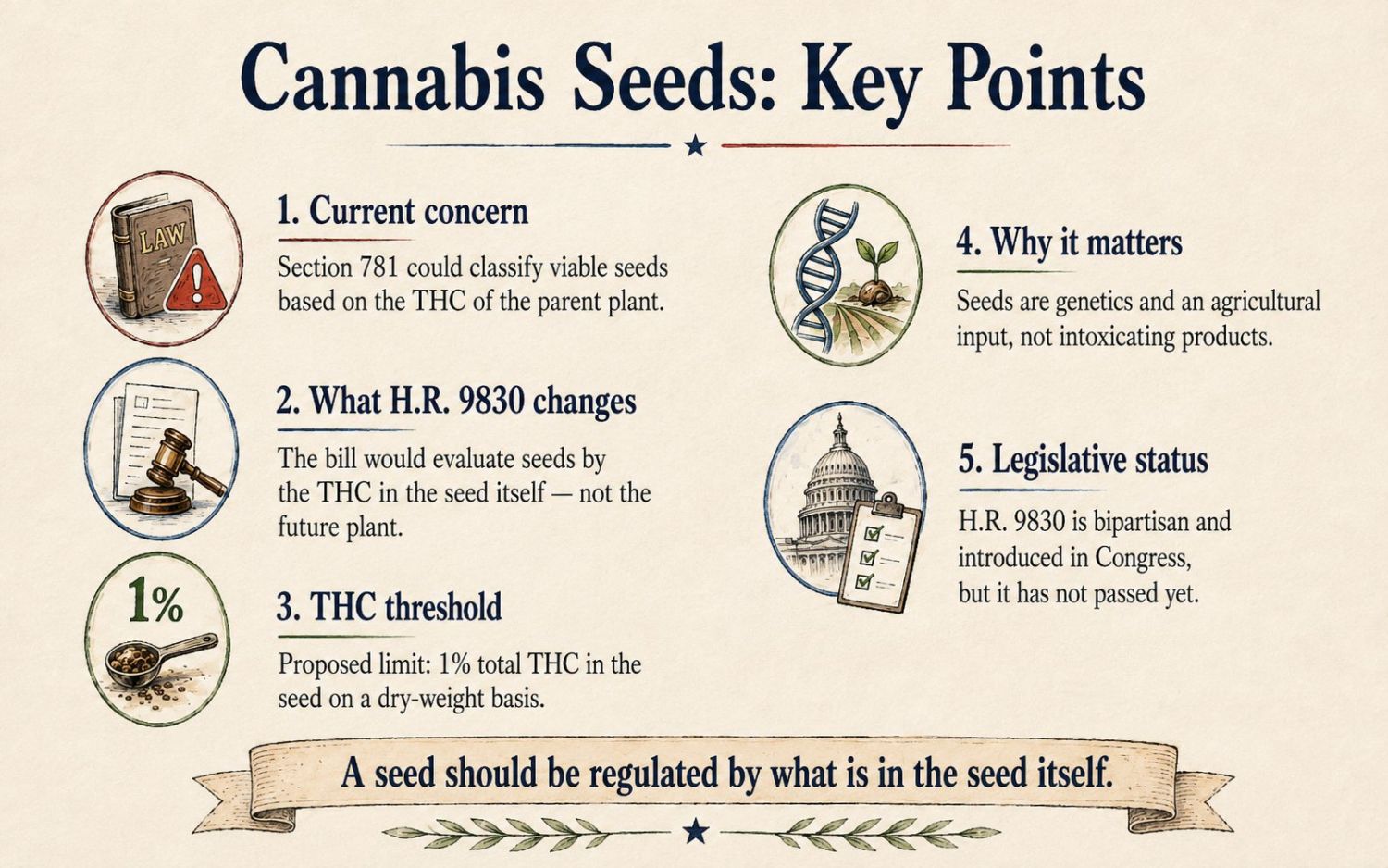
The concern comes from Section 781 of the FY2026 federal appropriations law. Under the language currently scheduled to take effect in November 2026, viable seeds could be excluded from the federal definition of hemp based not on what is actually contained in the seed, but on the THC concentration of the plant they came from.
For breeders, seed companies and growers, that’s a major distinction.
A cannabis seed itself is not an intoxicating product. Yet under this approach, its legal status could depend on the chemistry of its parent plant.
Now, for the first time, there is a concrete bipartisan proposal in Congress designed to address exactly that problem.
The Lawful Hemp Protection Act
On July 22, Representatives Andy Barr (R-KY) and Angie Craig (D-MN) introduced H.R. 9830, the Lawful Hemp Protection Act.
For the seed industry, one part of the bill is particularly important.
Instead of determining the status of a viable seed based on the THC concentration of the parent plant, the proposed legislation would look at the THC concentration of the seed itself, setting the relevant threshold at 1% total THC on a dry-weight basis.
That may sound like a small technical change but it isn’t.
It fundamentally changes how viable cannabis seeds would be treated.
Seeds Are Not Intoxicating Products
This has always been the central issue for us.
There is an important policy discussion happening in the United States around intoxicating hemp products, synthetic cannabinoids, THCA flower and consumer safety. But seeds are something different.
Seeds are genetics.
They are an agricultural input used by farmers, growers and breeders. The seed itself is not an intoxicating cannabis product.
This is why we believe seed policy should be based on the characteristics of the seed itself and not on what a plant grown from that seed might eventually produce.
That distinction is also at the center of the work being done by the American Seed Innovation & Growth Alliance (ASIGA), whose position is simple: “Seeds are agriculture, not intoxication.”
This Isn’t the Only Attempt to Change Section 781
H.R. 9830 is also not happening in isolation, other bipartisan efforts have been introduced to delay or repeal Section 781.
The Hemp Planting Predictability Act would extend implementation of the Section 781 changes from one year to three years. The Senate version, S. 3686, was introduced by Senators Amy Klobuchar, Rand Paul and Jeff Merkley.
H.R. 7024 proposes the same three-year implementation period in the House.
And H.R. 6209, the American Hemp Protection Act, proposes repealing Section 781 altogether.
None of this guarantees the outcome.
But it does show that the current language is being actively challenged from several directions and, importantly, across party lines.
What Happens Next?
H.R. 9830 has not passed Congress.
It has been introduced and referred to four House committees, so there are still several legislative steps before any of its provisions could become law.
The November deadline therefore remains something the seed industry has to take seriously.
But compared with where things stood several months ago, there is now something very important that didn’t exist before:
A specific legislative solution for viable seeds is actually on the table, and it addresses the fundamental problem directly.
For us, the principle is straightforward:
A seed should be regulated based on what is in the seed, not on what a plant grown from it might become.
We believe consumer protections around intoxicating products can exist without unnecessarily restricting seeds, plant breeding and genetic innovation.
We’ll continue following H.R. 9830 and the other proposals surrounding Section 781 and will update our community as the situation develops.
Comments